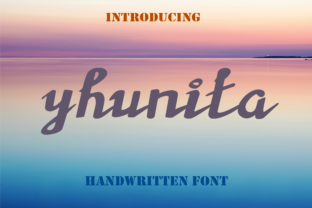
Yhunita: A Script Handwritten Font for Elegant Digital Branding
Last week, I was refining the hero section of a boutique coaching website—soft textures, warm neutral tones, and a clear value proposition front and center. The headline needed warmth, personality, and just enough distinction to feel human—not algorithmic. That’s when I dropped Yhunita into the mockup. Instantly, the tone shifted: Yhunita feels equally charming and elegant. Not flashy. Not forced. Just quietly confident—like a handwritten note from someone who knows your name and your values.
Yhunita for Logo Design and Brand Identity Systems
As a Script Handwritten font, Yhunita doesn’t try to be everything—it leans fully into its strength: evoking timeless craftsmanship. I tested it as the primary logotype for a small ceramics studio’s new website. Paired with a clean, low-contrast sans serif (think Inter or Manrope) for body copy and navigation, Yhunita became the brand’s quiet signature—used only in the logo and occasional section dividers. No overuse. No visual fatigue. Just consistent elegance across desktop, mobile, and social profile headers. Because Yhunita is a premium Fonts choice, it carries weight without shouting—ideal for brands that prioritize authenticity over attention-grabbing gimmicks.
Yhunita for Social Media Graphics and Campaign Landing Pages
When building a limited-time workshop campaign landing page, I used Yhunita for the headline (“Your First Hand-Lettered Journal Starts Here”) and subheadline (“A 3-week creative reset—no experience needed”). On mobile, I checked letter spacing and line height carefully: Yhunita performs best at 32–48px on desktop and 28–36px on mobile, with generous tracking. It’s not a body font—but as a display Script Handwritten typeface, it creates instant mood and memorability. For Instagram carousels and email banners, I exported static PNGs with Yhunita text overlaid on muted linen textures. The result? Higher dwell time in preview mode—readers paused longer before swiping. That subtle pause matters. It’s where intention meets attention.
Yhunita for Blog Headers and Editorial Website Typography
I recently refreshed a slow-growing design blog’s homepage layout—and swapped the default serif header font for Yhunita on article titles only. Not every title. Just the featured post and category headers. Why? Because Yhunita thrives in moments of emphasis. Its calligraphic rhythm—gentle entry strokes, soft exits, balanced contrast—adds narrative texture without compromising scannability. On light backgrounds, it reads cleanly at 36px+ with 1.3 line height. Over subtle image overlays, I added a soft white drop shadow (1px blur, 2px offset) to ensure legibility without losing its organic flow. As a Fonts asset, Yhunita isn’t meant for long paragraphs—but it makes short-form editorial content feel intentional, curated, and deeply human.
Yhunita for Online Store Banners and Product Page Accents
For a handmade paper goods shop, I applied Yhunita to banner text (“Hand-Cut • Hand-Stamped • Heart-Led”) and product feature tags (“Limited Edition”, “Personalized”). Crucially, I avoided using it for price tags, CTAs, or filters—those stayed in a highly legible sans serif. This hierarchy worked because Yhunita is, at its core, a Script Handwritten font built for emotional resonance, not functional scanning. On dark-mode previews, I tested contrast: Yhunita holds up well against charcoal or deep navy if the weight remains medium (not thin), and letterforms aren’t overly condensed. Always check the included webfont files—many Fonts like Yhunita offer OTF, WOFF2, and variable options for optimal loading and rendering.
Yhunita for Portfolio Websites and Creative Service Pages
A freelance lettering artist asked me to redesign her portfolio site. Her work is tactile, ink-based, full of variation—so her site needed typography that echoed that spirit without competing. Yhunita became the anchor: used only in the site header (“Maya Chen • Lettering & Identity”), project category labels (“Branding”, “Editorial”, “Packaging”), and the closing signature line. Everything else—project descriptions, contact form, footer—used a crisp, airy sans. That contrast elevated her craft. It also reinforced trust: choosing Yhunita signaled intentionality. Clients don’t hire fonts—they hire the feeling a font helps convey. And Yhunita feels equally charming and elegant in exactly the way a creative professional wants to be perceived.
Yhunita Font Pairing Tips for Web Designers
Pairing Yhunita successfully comes down to restraint and role clarity. Think of it as the lead vocalist—not the backing band. My go-to pairings:
- For modern minimalism: Yhunita + Inter (light/regular weights for body, medium for captions)
- For editorial warmth: Yhunita + Cormorant Garamond (italic for pull quotes, regular for bylines)
- For high-contrast digital kits: Yhunita + Space Grotesk (bold for CTAs, thin for fine print)
Always test fallback behavior. If Yhunita fails to load, your CSS stack should gracefully shift to a system script or generic sans—never leave users staring at invisible text. And before licensing: confirm commercial use rights, multilingual character support (especially accented characters for global audiences), and whether stylistic alternates or ligatures are included—these details elevate polish in client-facing Fonts projects.
Yhunita for Branded Email Signatures and Digital Brand Kits
In a recent brand kit refresh for a wellness coach, I embedded Yhunita into email signature templates, Canva social templates, and Notion brand guidelines. Why? Because consistency across touchpoints builds subconscious recognition—and Yhunita delivers that signature flourish without clutter. Used sparingly (name only, or name + tagline), it transforms functional assets into brand moments. As a Script Handwritten font, it bridges digital and analog perception—making emails feel hand-signed, slides feel thoughtfully composed, and PDFs feel like keepsakes. That’s the power of choosing the right Fonts: not just how it looks, but how it makes people feel when they see it—even for half a second.